
Barnard's Star is orbited by four small, rocky planets

This was written for The Conversation (this being my original edit of the piece)
Barnard's Star is a small, dim star, of the type that astronomers call red dwarfs. Consequently, even though it is one of the closest stars, such that its light takes only six years to reach us, it is too dim to see with the naked eye. And much, much too dim to be seen, even with the best telescopes that we have, are the four small planets that we now know to be in close orbits around the star.
Few stars are named after astronomers. The bright, naked eye stars were named in the golden era of Arabic science, while fainter stars typically just have catalogue numbers. But in 1916 Edward Emerson Barnard noticed that this star was moving in the night sky. It is so close to us that its motion through space can be seen against the backdrop of stars that, being much more distant, appear fixed.
How were the orbiting planets found if they're much too dim to be seen? The answer lies in detecting the effect of their gravity on the star. The mutual gravitational attraction keeps the planets in their orbits, but also tugs on the star, moving it in a rhythmic dance that can be detected by sensitive spectrographs designed to measure the star's motion.
A significant challenge, however, is the star's own behaviour. Stars are fluid, with the nuclear furnace at their core driving churning motions that generate magnetic fields (just as the churning of Earth's molten core produces Earth's magnetic field). The surface of red-dwarf stars are rife with magnetic storms that cause giant flares and dark "star spots", and these can mimic the effect of planets.
The task of finding planets by this method boils down to building the most-sensitive spectrographs possible, mounting them on large telescopes that feed sufficient light, and then observing a star over months or years. After carefully calibrating the resulting data, and modelling out the effects of stellar magnetic activity, one can then scrutinise the data for the tiny signals that reveal orbiting planets.
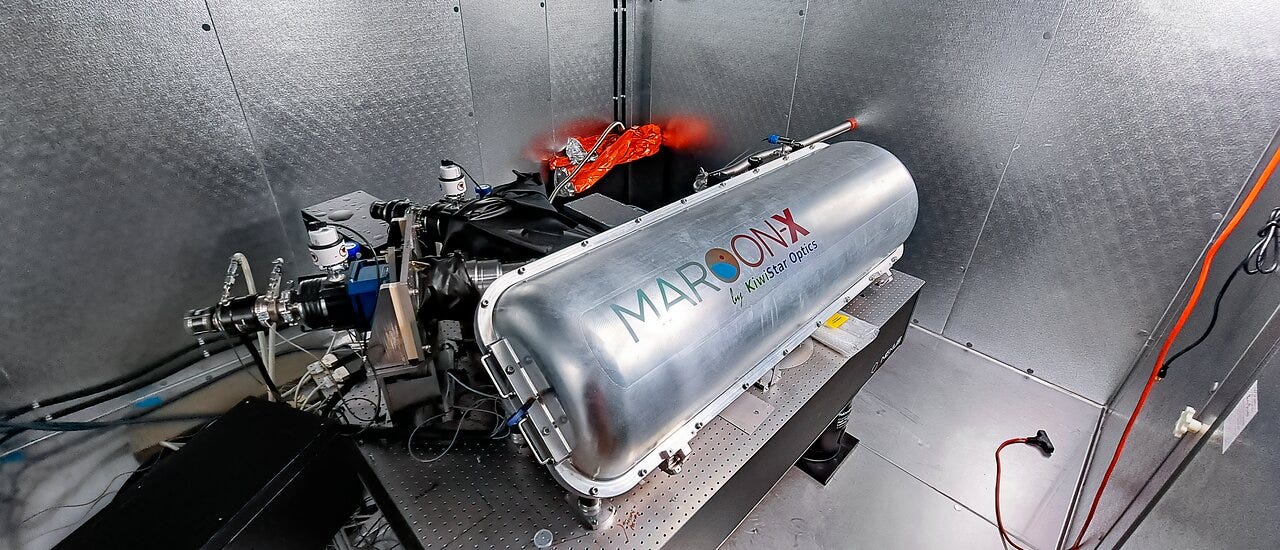
In 2024 a team led by Jonay González Hernández reported on four years of monitoring of Barnard's Star with the ESPRESSO spectrograph on ESO's Very Large Telescope. They found one secure planet and reported tentative signals that could indicate three more planets. Now, a team led by Ritvik Basant have added in three years of monitoring with the MAROON-X instrument on the Gemini-North telescope. Analysing their data alone confirmed three of the four planets, while combining both datasets confirms that all four are real.
Often in science, when detections push the limits of current capabilities, one needs to ponder the reliability of the findings. Are there spurious instrumental effects that the teams haven't accounted for? Hence it is reassuring when independent teams, using different telescopes, instruments and computer codes, arrive at the same conclusions.
The planets form a tight, close-in system, having orbital periods between 2 and 7 Earth days (for comparison, our Sun's closest planet, Mercury, orbits in 88 days). Most likely they all have masses less than Earth. They're likely to be rocky planets, with bare-rock surfaces blasted by their star's radiation. They'll be too hot to hold liquid water, and any atmosphere is likely to have been stripped away.
The teams looked for longer-period planets, further out in the star's habitable zone, but didn't find any. We don't know much else about these planets, such as their sizes. The best way of figuring that out would be to watch for transits, when planets pass in front of their star, and then measure how much light they block. But the Barnard's Star planetary system is not edge on to us, so the planets don't transit, and that makes them harder to study.
Nevertheless, the Barnard's Star planets tell us about planetary formation. They'll have formed in a protoplanetary disk swirling around the nascent star. Particles of dust will have stuck together, and gradually built up into rocks that aggregated into planets. Red dwarfs are the most common type of star, and most of them seem to have planets. Whenever we have sufficient observations of such a star we find planets, so likely there are far more planets in the galaxy than there are stars.
Most of the planets that have been discovered are close to their star, well inside the habitable zone, but that's largely because their proximity makes them much easier to find. Being closer in means that their gravitational tug on their star is bigger, and it means that they have shorter orbital periods (so we don't have to monitor the star for as long). It also increases their likelihood of transiting, and thus of being found in transit surveys. ESA's upcoming PLATO mission is designed to find planets further from their stars. This should produce many more planets in their habitable zones, and should begin to tell us whether our own Solar System, which has no close-in planets, is unusual.